7 Signs Your Ferritin Is Low — Even If Your Doctor Says You're "Normal"
Why so many female endurance runners are training hard, doing everything right, and still hitting a wall their bloodwork can't explain.

By Megan Callahan
Marathoner (2:58 PR) & running coach | Written for the running community | Updated August 2026

I did everything the plan asked for. Base miles in the dark, tempo work on Tuesdays, long runs that ate my Sundays. For years that formula worked — I'd show up on race day and my body would answer. Then, sometime last spring, it stopped answering.

It wasn't dramatic. My legs just felt heavy, even on the easy days that used to feel like nothing. My splits drifted slower while my effort climbed higher. I slept eight hours and woke up feeling like I hadn't. I missed a PR I'd trained a full cycle for and spent the drive home trying to figure out what I'd done wrong.
So I did the responsible thing and got bloodwork. My doctor scanned the panel, told me everything was in range, and suggested I might be overtraining or just stressed. I left with a clean report and absolutely no answer.
If any of this sounds familiar, you're not imagining it — and you're not alone. Here's what's actually going on.
- 1
Heavy legs on easy runs, not just hard ones
Even easy-paced runs feel like a grind, when they used to feel effortless.

- 2
Pace slower than your training says it should be
Your mileage and consistency haven't changed, but your splits have.
- 3
Wiped out even after a full night's sleep
Fatigue that doesn't resolve with rest is a different kind of tired.

- 4
Hair thinning you can't explain
A symptom that shows up far from the track, but often traces back to the same root cause.

- 5
“Normal” labs that still leave you feeling off
Standard lab ranges were never built with athletes in mind.

- 6
Slow recovery between hard sessions
Taking longer than usual to bounce back after a tough workout or long run.
- 7
A general sense that something's “off” you can't quite name
Sometimes it's not one dramatic symptom, just a persistent sense that you're not operating at 100%.
If two or more of these sound familiar, there's a good chance the missing piece isn't more training, more sleep, or more willpower. Here's the mechanism nobody explains.
What's Actually Happening (And Why Standard Advice Misses It)
Every stride is quietly draining you
Every time your foot hits the ground, the repetitive impact breaks down a small number of red blood cells. It's called foot-strike hemolysis, and across the volume a distance runner accumulates week after week, those small losses add up. It's a drain that non-runners simply don't experience — which is exactly why generic advice doesn't account for it.

Your body blocks absorption after hard training
Hard sessions spike hepcidin, a hormone that acts like a gate on iron absorption. For hours afterward, that gate is partly closed. So the post-run window many runners instinctively use for their supplement is often the worst possible time to take it — meaning even a solid diet or a decent generic supplement can quietly underperform if the timing is wrong.

Standard labs weren't built for athletes
A ferritin level of 15 ng/mL will often read as "normal" on a standard lab panel, while sports-medicine literature puts the athlete range closer to 30-100 ng/mL. That's a wide gap — and it's why so many runners can have a real deficiency and a "normal" result at the same time.
This isn't a fringe theory. This is grounded in real exercise physiology research on foot-strike hemolysis and exercise-induced hepcidin suppression — not a wellness trend.
This Is Why We Built Full Stride

Once the mechanism was clear, the fix became fairly obvious. If iron is being lost through impact and blocked by post-run hepcidin, then the answer isn't simply "take iron" — it's take the right forms, at the right dose, at the right time.
So Full Stride uses dual-pathway iron: iron bisglycinate paired with plant ferritin. Two distinct absorption routes instead of one. It comes with a training-synced dosing protocol — 3+ hours before or 6+ hours after running — specifically to sidestep the 2-4 hour post-run hepcidin peak.
And it's dosed at correction tier: 25-28mg of elemental iron. That's built to correct a real deficiency, not to maintain a number that's already borderline.
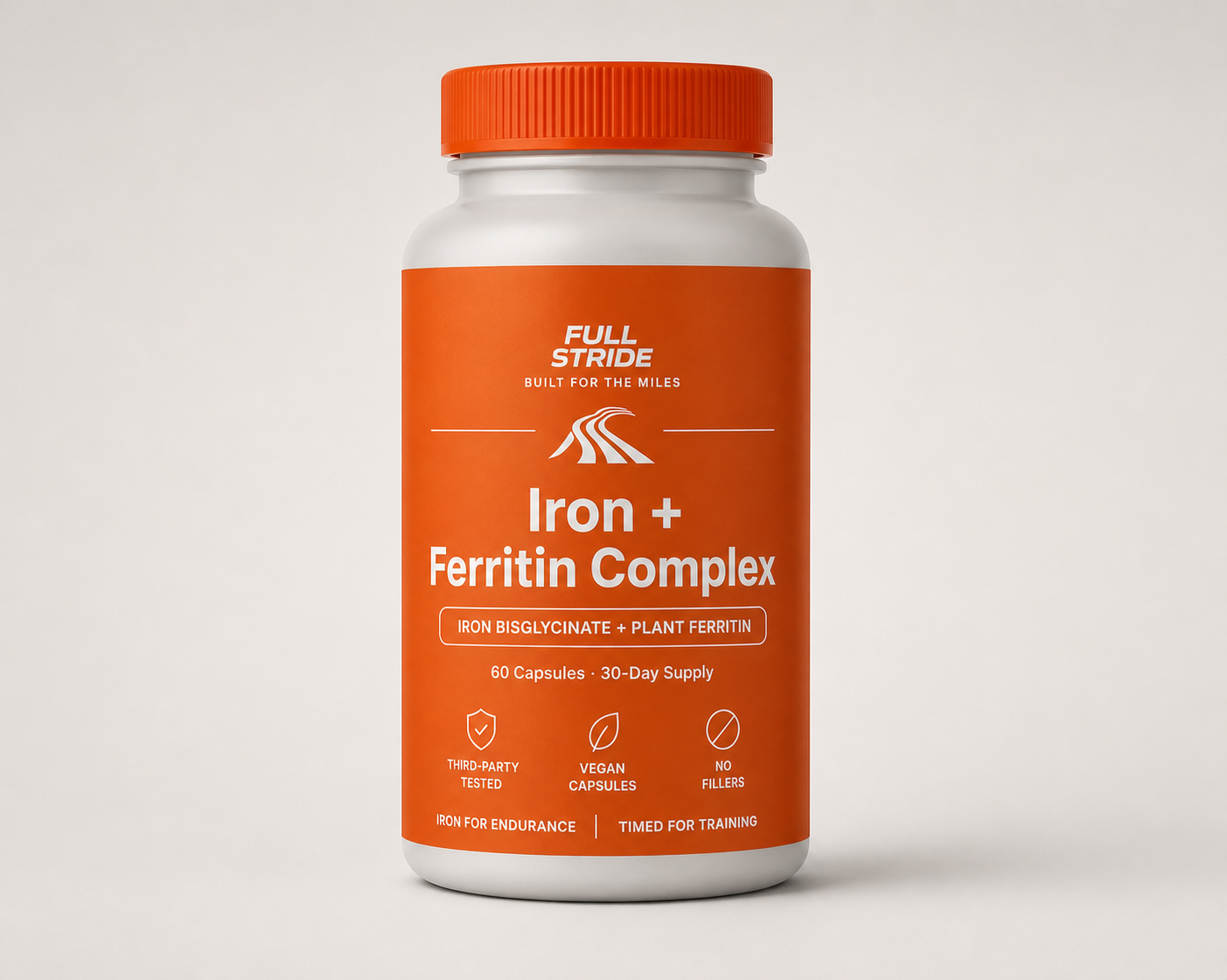
Full Stride — Iron + Ferritin Complex
How Full Stride Compares
| Full Stride | Typical Iron | |
|---|---|---|
| Elemental Iron Dose | 25-28mg | 5-18mg |
| Absorption Pathways | 2 (dual) | 1 (single) |
| Training-Synced Timing Protocol | Included | Not included |
| Gut Tolerance | Gentle | Often harsh |
| Third-Party Tested | Every batch | Varies |
| Built For Endurance Runners | Yes | Generic formula |
Real Runners, Real Retests

"My ferritin was 14. My doctor said within range. Eight weeks on Full Stride and my retest came back at 38 — and my long runs finally stopped feeling like survival mode."

"I'd already switched to bisglycinate and it still wasn't moving my numbers. Turns out I was taking it right after my runs. The timing protocol alone might've been the fix."

"Finished my last half sitting in the grass at mile 11. This time I finished strong. I can't say it's only the iron, but my ferritin retest doesn't lie."
What's Actually In Every Capsule
Iron Bisglycinate (25-28mg)
Highly bioavailable, gentler on the gut than ferrous sulfate
Plant Ferritin
A second, distinct absorption pathway
Vitamin C (100-120mg)
Supports iron absorption
Copper Bisglycinate (1mg)
Helps mobilize stored iron
Vitamin B12 (100mcg)
Supports energy metabolism
Folate (400mcg DFE)
Supports red blood cell production
Try Full Stride Today
1 Bottle
$44
reg. $58
$1.47/day
2 Bottles
$74.80
reg. $116
$1.25/day
- Free Shipping
- Free Full Stride Training Kit
3 Bottles
$99
reg. $174
$1.10/day
- Free Shipping
- Free Full Stride Training Kit

Try It Risk-Free
We know what it's like to try supplement after supplement and see nothing change. That's why every order is backed by a 30-day money-back guarantee. If you don't notice a real difference in how your training feels, we'll make it right.